Nada Yoga Course in Nepal — Himalayan Sound Healing Mastery
Nada Yoga Course in Nepal — Himalayan Sound Healing Mastery
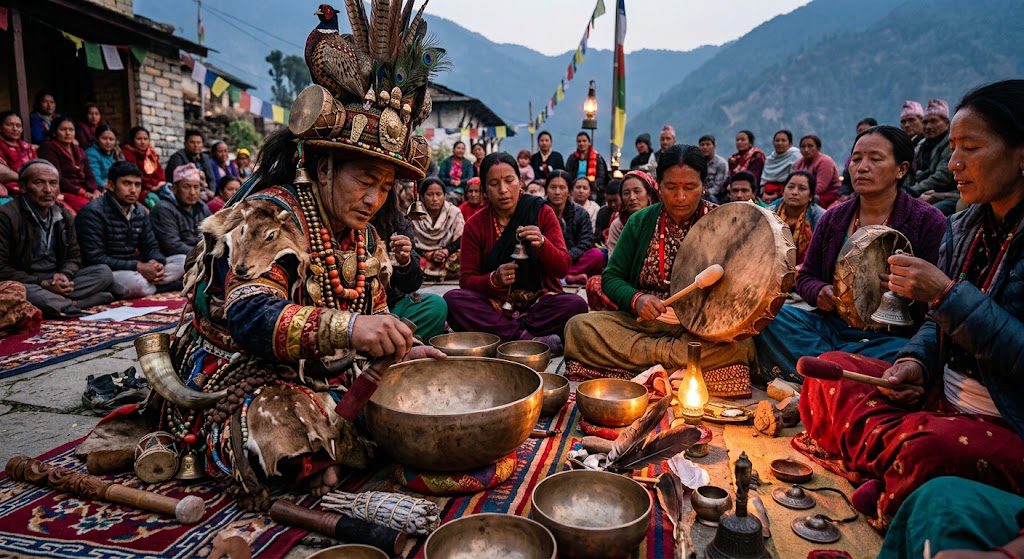
Discover the ancient science of Nada Yoga — the yoga of sacred sound — at Himalayan Nada Sound Healing Studio in Thamel, Kathmandu. Guided by a teacher with 27 years of music experience, our hands-on courses take you from your very first bowl stroke to professional-level sound healing.
Nada Yoga: The Ancient Science of Sound and Vibration
Nada Yoga is the classical Indian path of yoga that uses sound, vibration, and frequency to quiet the mind, dissolve the ego, and unite individual consciousness with the divine source. It is a journey from outer sound into profound inner stillness — the yoga of listening.
The Meaning Behind Nada Yoga
The Sanskrit word Nada comes from the root nad, meaning “to flow” or “stream of consciousness,” while Yoga means “union.” Together, they describe the merging of awareness with the flowing current of sound itself.
This philosophy rests on a timeless premise: the entire universe originated from a primordial vibration, or sound, often symbolized as Om / AUM, or Nada Brahma — the sound that is God. Everything that exists is, in its essence, vibration.
The teachings of Nada Yoga are preserved in ancient texts, including the Nada-Bindu Upanishad, the Hatha Yoga Pradipika, the Shiva Samhita, and the Yoga Sutras of Patanjali.
The Two Types of Sound
Nada Yoga divides sound into two primary categories, forming a bridge from the external world to inner realization.
1. Ahata Nada — Struck or External Sound
This is sound produced by physical friction or mechanical action — plucking a string, beating a drum, chanting mantras, or playing singing bowls. Audible to the physical ears, Ahata Nada serves as a gateway that focuses and settles the mind.
2. Anahata Nada — Unstruck or Internal Sound
This is the internal, subtle, and continuous vibration that does not arise from two things striking together. It is heard inwardly during deep states of meditation and pratyahara (sense withdrawal), and is experienced as an internal symphony — or as silence itself.
Key Practices of Nada Yoga
- Toning & Voice — The human voice is considered the primary instrument in Nada Yoga. Practitioners produce basic tones, such as the foundational note “Sa,” and let them resonate through the body’s energy centers.
- Mantra & Chanting — Reciting sacred sounds clears the subtle channels (nadis) and harmonizes the chakras.
- Indian Classical Ragas — Listening to or singing traditional ragas, each linked to a specific psychological and emotional state.
- Sound Healing Instruments — Working with external acoustic tools such as Tibetan singing bowls, gongs, tuning forks, and flutes to synchronize brain waves and calm the nervous system.
The Benefits of Nada Yoga
- Nervous System Regulation — Rhythmic frequency and vibration lower stress hormones, tension, and anxiety, bringing the body into a state of deep rest.
- Deepened Meditation — Nada Yoga replaces mental chatter with a single point of auditory focus, guiding the mind from gross noise into deep inner stillness.
- Spiritual Awakening — By aligning the internal energy fields, Nada Yoga cultivates clarity, emotional balance, and, ultimately, Samadhi — the state of liberation and union.
What You’ll Learn
- Nada Yoga fundamentals: Ahata (struck) and Anahata (unstruck) sound
- Himalayan singing bowl playing and healing techniques
- Chakra balancing, Bija mantras, and meditation
- Kundalini energy balance and Vedic sound principles
- Playing additional instruments: gongs, tingsha, drums, didgeridoo, river beans, rain sticks, and more
Course Levels
- Basic — 10 hours, USD 200: Foundations of sound healing and singing bowls.
- Intermediate — 21 hours, USD 300: Deeper technique, chakra work, and energy work.
- Professional — 50 hours, USD 500: The complete 7-Day Nada Yoga & Himalayan Singing Bowl Mastery course (17 modules), including Yoga Nidra, Pranayama, outdoor practice, and performance.
Why Learn With Us
- An experienced teacher with 27 years in music
- Certificate of experience on completion
- In-person sessions, online classes, and a full-day outdoor practice trip
- Located in the heart of Thamel, Kathmandu