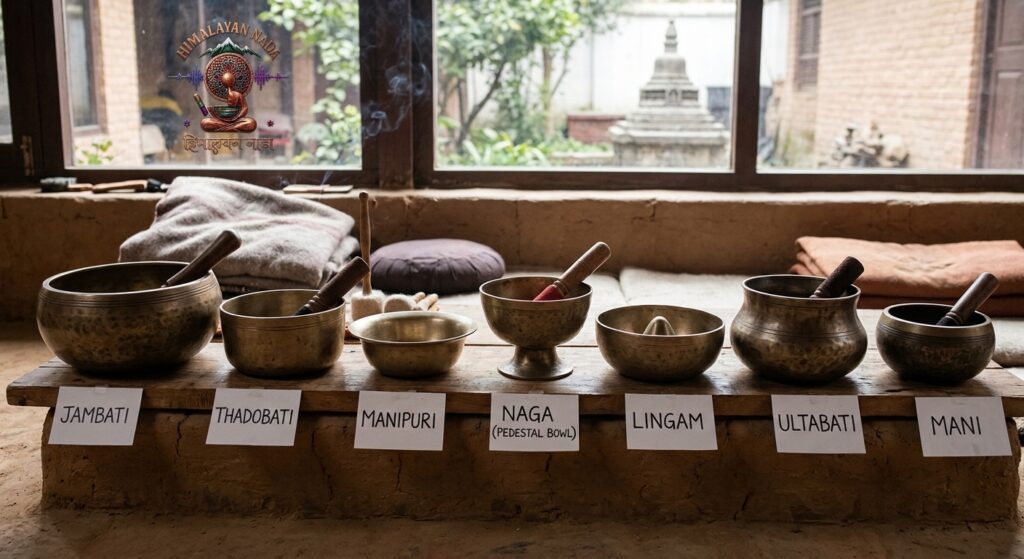
Part 2: Traditional Types of Singing Bowls
Hand-hammered Himalayan singing bowls are traditionally forged from a bronze alloy (commonly copper and tin, sometimes containing trace amounts of iron, zinc, silver, or gold, known symbolically as Panchaloha or seven-metal alloys). They are categorized by their distinct shapes, wall thicknesses, and acoustic profiles:
1.Jambati
-
Shape: Large, deep, wide-mouthed bowls with thick walls that curve smoothly upward and often feature a subtle inward-curving lip.
-
Sound: Produces a deep, rich, grounding bass fundamental tone with long sustain and warm overtones.
-
Best Use: Sound baths, group sessions, and grounding work (often associated with lower energy centers).
2. Thadobati
-
Shape: Straight-sided walls with a flat bottom and a near-right-angle transition from the base to the wall.
-
Sound: Clear, balanced, and focused tone with strong harmonic overtones and steady resonance.
-
Best Use: Personal meditation, vocal toning accompaniment, and targeted vibrational placement on or near the body.
3.Manipuri
-
Shape: Shallow, wide-brimmed bowls with thin walls and a flared rim.
-
Sound: Bright, sweet, shimmering high-to-mid-range tones that respond quickly to light strikes or rimming.
-
Best Use: Clearing energy, gentle meditation, and creating airy, uplifting harmonic layers.
4.Naga (Pedestal Bowl)
-
Shape: A bowl fused onto a raised circular base or pedestal, resembling a chalice.
-
Sound: High, bell-like, crisp, and crystalline ring with sharp projection.
-
Best Use: Ceremonial openings, space clearing, and high-frequency sound accents.
5.Lingam
-
Shape: Rare bowls featuring a raised central cone or mound inside the bottom of the bowl, symbolizing Shiva in Hindu/tantric iconography.
-
Sound: Complex, multi-layered, and powerful resonance with distinct tonal shifts depending on where it is struck.
-
Best Use: Ritual practice, deep contemplative meditation, and collectors.
6.Ultabati
-
Shape: Large bowls with curved walls that flare outward near the middle and curve inward sharply at the rim, creating a bulbous profile.
-
Sound: Deep, booming, and complex resonant waves with strong, slow-pulsing vibrato (beat frequencies).
-
Best Use: Immersive soundscapes and deep somatic relaxation.
7. Mani
-
Shape: Very thick-walled, smaller bowls with a heavy, inward-curving lip.
-
Sound: Extremely high-pitched, bright, pure, and piercing tone with exceptionally long sustain.
-
Best Use: High-frequency focus, mental clarity, and pairing with deep Jambati bowls for wide harmonic contrast.
Part 3: Modern Variations
Alongside traditional hand-hammered bronze bowls, two major modern categories are widely used today:
-
Machine-Lathed / Cast Brass Bowls: Mass-produced in India and Nepal using molds and lathes. They have a uniform, polished appearance and a consistent, single-note ring, making them affordable and reliable for beginners, though they lack the complex harmonic overtones of hand-forged bowls.
-
Quartz Crystal Singing Bowls: Developed in the late 20th century from crushed quartz sand spun in high-heat molds (originally an offshoot of semiconductor manufacturing). They produce a loud, pure, enveloping sine-wave tone that fills large rooms effortlessly, though with fewer complex overtones than multi-metal Himalayan bowls.